Skip to Main Content
Introduction to Unit 6: Political Participation and Elections, featuring a government building background.
Document showcasing the Preamble to the Constitution of the United States on a parchment background.
Image of a historical document and a portrait of Abraham Lincoln, discussing political institutions and social justice.
Document titled "Simulating Popular Sovereignty" discussing a town council proposal for a new sports complex.

Government & Politics Unit 6 – Activities + Essays

59 minutes

44 Items

Document showcasing the Preamble to the Constitution of the United States on a parchment background.
Image of a historical document and a portrait of Abraham Lincoln, discussing political institutions and social justice.
Document titled "Simulating Popular Sovereignty" discussing a town council proposal for a new sports complex.
Text from a document titled "The History of Political Parties in the United States" with paragraph content.
Text from an historical document discussing governance, factions, and civil rights for citizens.
Table outlining analysis questions related to the Republican Party platform and founding principles.
Table comparing campaign finance legislation and Supreme Court decisions, including key legislation, goals, and outcomes.
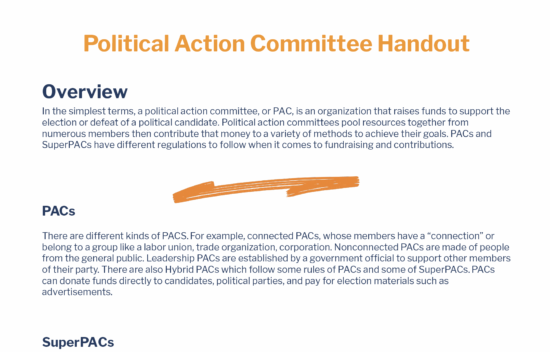
Political Action Committee handout outlining definitions and differences between PACs and SuperPACs.
Text excerpt from the Supreme Court opinion in Citizens United v. FEC (2010) by Justice Kennedy.
Text from a case study titled "Campaign Finance" discussing election funding in the United States.
Infographic illustrating the organizational structure of U.S. political parties with roles and committees at various levels.
Image of the Supreme Court justices with text "Baker v. Carr" and "Supreme Court Homework Help" over an orange background.
The video discusses the origins of partisanship in American politics, featuring animated historical figures.
Black and white portrait of a man in a suit standing beside a large column.
Text discussing the history of voting restrictions and expanding suffrage in the United States.
Text of the Twenty-Third Amendment to the U.S. Constitution regarding voting rights for District of Columbia residents.
Document outlining the role of state governments in elections, featuring the U.S. Constitution from 1787.
Line graph depicting U.S. presidential and midterm election turnout rates from 1789 to the present.
A timeline with events related to voting rights and the U.S. Constitution, including dates and brief descriptions.
A table comparing statements about federalism, elections, and political party nominations.
Decorative image.
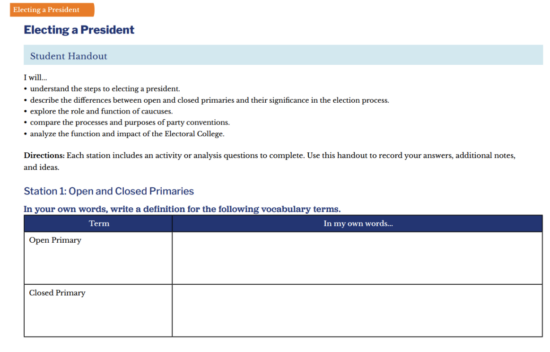
Student handout for "Electing a President" with sections on primaries and the Electoral College.
An excerpt from Federalist #10 discussing the dangers of factions in a free society with vocabulary definitions.
Decorative image.
Text from a primary source on Electoral College from Federalist #39, authored by James Madison, 1788.
Graphic organizer for researching the expansion of voting rights, including prompts and sections for amendments and legislation.
A text-based graphic discussing the Voting Rights Act, its impact, and related questions on justice for African Americans.
The Electoral College video thumbnail from BRI's Homework Help Series featuring historical figures.
Table outlining objectives, vocabulary, and building context for Federalist #51, discussing governance and majority rule.
Infographic comparing small and large republics in relation to the problem of factions in Federalist #10.
Infographic for interest group analysis with guiding questions, objectives, and chart for data collection.
Infographic outlining action steps for interest groups to influence government decisions and policies.
Text from a document titled "Nixon-Kennedy Televised Debate" with historical context about the event.
Infographic analyzing the impact of media technology on presidential campaigns and voter engagement through history.
Text on a document discussing watchdog reporting and the role of media in government accountability.
Graphic organizer outlining media's limitations and benefits, guiding questions, and objectives for analysis and discussion.
The image features a document titled "Media Source Analysis and Reflection" with guiding questions and objectives listed.
A document outlining how news media presents information using a basketball example with objectives and presentation styles.
A table with three columns titled "Coverage," "Analysis," and "Commentary," each containing space for information.
Image of the Supreme Court building with text: "Citizen United v. Federal Election Commission" and "Bill of Rights Institute."