Skip to Main Content

#PrinciplesandVirtues

The American Principles and Virtues shape our republic with ordered liberty and help form the conscience of the nation.

Download the Student Handouts

Middle & High School Student Handout

Definitions that are approachable for students learning American Government and/or U.S. History.

Download Student Handout

Elementary Student Handout

Definitions that are approachable for little learners.

Download Student Handout

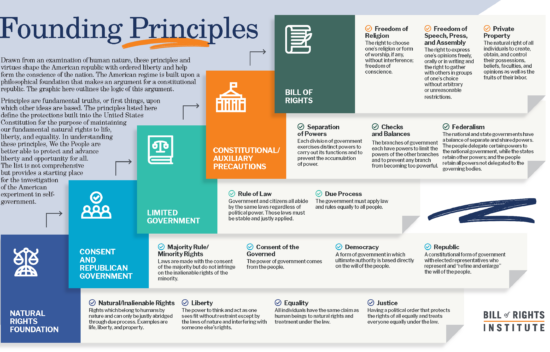
Founding Principles Definitions

These are the philosophical principles which provide the focus for the governing structure of the United States. Introductory videos to many of the topics are provided.

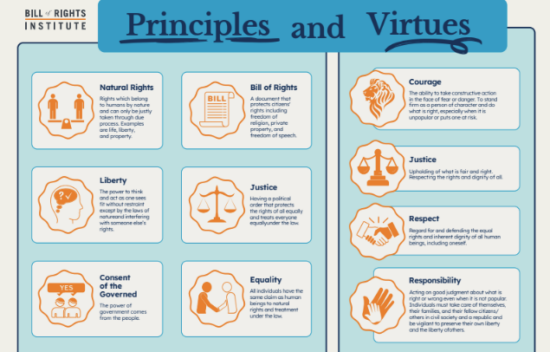
  • Natural/Inalienable Rights: Rights which belong to humans by nature and can only be justly abridged through due process. Examples are life, liberty, and property.
  • Liberty: The power to think and act as one sees fit without restraint except by the laws of nature and interfering with someone else’s rights.
  • Equality: All individuals have the same claim as human beings to natural rights and treatment under the law.
  • Justice: Having a political order that protects the rights of all equally and treats everyone equally under the law.

These principles of republicanism provide the foundations upon which the sovereignty of the people within government is maintained.

  • Majority Rule/Minority Rights: Laws are made with the consent of the majority but do not infringe on the inalienable rights of the minority.
  • Consent of the Governed/Popular Sovereignty: The power of government comes from the people.
  • Democracy: A form of government in which ultimate authority is based directly on the will of the people.
  • Republic: A constitutional form of government with elected representatives who represent and “refine and enlarge” the will of the people.

To keep the governing power to its proper scope, government must be limited and provide recourse for citizens to be protected from arbitrary power.

  • Rule of Law: Government and citizens all abide by the same laws regardless of political power. Those laws must be stable and justly applied.
  • Due Process: The government must apply laws and rules equally to all people.

To keep government within these limited bounds, there must be rules that bind both individual citizens and government action.

  • Separation of Powers: The branches of government each have powers to limit the powers of the other branches and to prevent any branch from becoming too powerful.
  • Checks and Balances: Constitutional powers are distributed among the branches of government allowing each to limit the application of power of the other branches and to prevent expansion of power of any branch.
  • Federalism: The national and state governments have a balance of separate and shared powers. The people delegate certain powers to the national government, while the states retain other powers; and the people retain all powers not delegated to the governing bodies.

As a final recourse against government abuse, the Founding generation codified a list of rights that they believed were essential to the maintenance of their constitutional governing structure.

  • Freedom of Religion: The right to choose one’s religion or form of worship, if any, without interference; freedom of conscience.
  • Freedom of Speech, Press, and Assembly: The right to express one’s opinions freely, orally or in writing, and the right to gather with others in groups of one’s choice without arbitrary or unreasonable restrictions.
  • Private Property: The natural right of all individuals to create, obtain, and control their possessions, beliefs, faculties, and opinions as well as the fruits of their labor.

Virtues & Vices Student Handout

Contains definitions appropriate for middle & high school students.


Virtues & Vice Video Library

Short videos that correspond with lessons from our Heroes & Villains curriculum.